
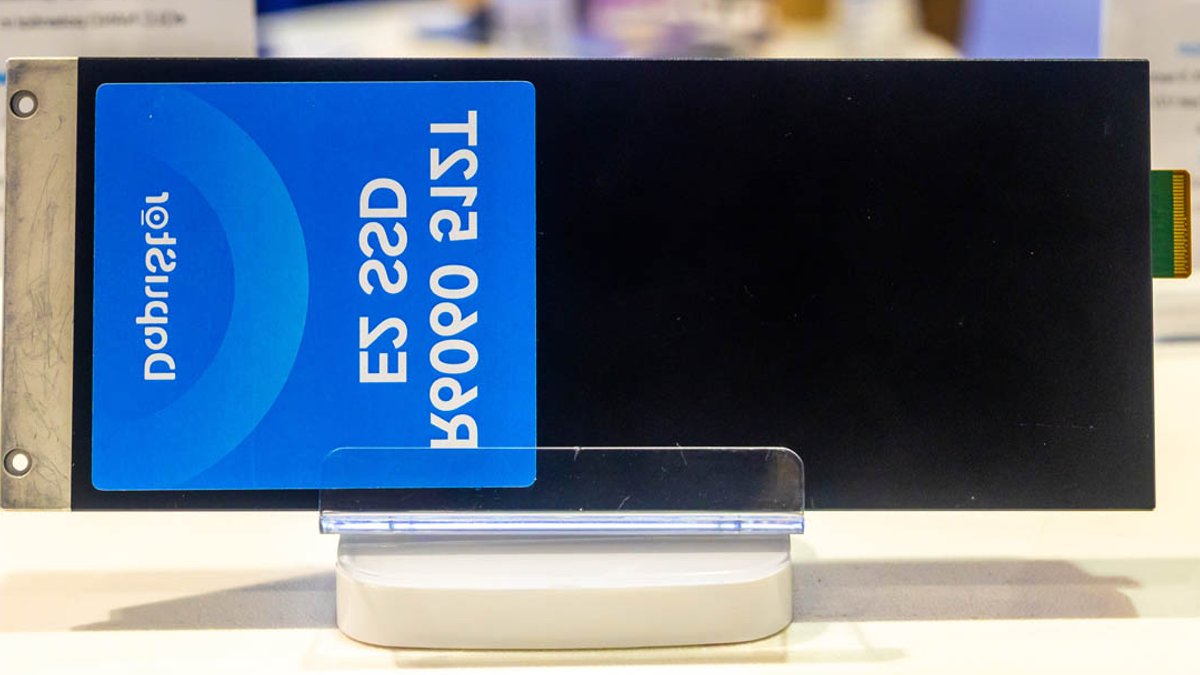
At this year’s FMS2026, the atmosphere was more optimistic than the previous year. NAND and DRAM vendors reported record demand, though one trend shifted unexpectedly: the industry’s focus on larger solid-state drives slowed until DapuStor introduced its 512TB E2 NVMe SSD.
The R6060, part of the company’s high-capacity lineup, uses the E2 form factor designed to optimize NAND placement. While other DapuStor drives, such as the Xlenstor2 X2900P and Haishen5 H5100, serve data-intensive applications, the R6060 doubles the storage of its closest rivals. Most high-end SSDs in E3.L or U.2 formats max out at 256TB. The E2 form factor adds a few millimeters in depth and width, allowing for additional NAND chips—and, in this case, half a petabyte of storage.
A single server, 16 petabytes
A server equipped with 36 E2 drive bays could hold 16PB of raw storage. For businesses training AI models or managing large media libraries, the benefits are clear: attaching more capacity to a given CPU or dual CPU server. That, in turn, tends to lower the costs of getting storage online because you need fewer memory modules, chassis, motherboards, and so on. If you are optimizing for power, then having fewer CPUs, NICs, memory, and so forth also means a lower power envelope.
DapuStor’s smaller drives, like the 245.76TB Roealsen6 in E3.L and E1.L formats, already address similar needs. The E2’s edge lies in its ability to handle more NAND placements than E3.L drives by adding a few millimeters more of depth and width to the devices. With NAND pricing driving system expenses, the E2’s flexibility may help balance those costs.
Related: Potentials & Qualities of a Sound SEO Company
The move toward high-density SSDs reflects broader changes in storage use. Hard drives once dominated data centers, but their performance limitations created bottlenecks for modern workloads. Now, SSDs are so compact that one drive can replace an entire rack of hard drives. The R6060 demonstrates how far the industry has advanced in a decade.
For companies like Meta, which has emphasized its need for massive, low-latency storage, the E2 form factor offers significant advantages. Meta Ross E2 QLC in the real world shows how a 512TB drive allows packing more data into fewer systems. That reduction simplifies logistics in data centers where space and cooling are limited.
Yet the R6060 has drawbacks. NAND pricing fluctuates, and a drive of this size won’t be affordable. DapuStor didn’t share exact pricing, but I would expect it to be a lot given current NAND pricing.
Most consumers will never use a 512TB SSD. Still, the effects of such advancements will reach them. Cloud services, streaming platforms, and AI tools rely on the kind of storage density the R6060 represents. When a single server holds 16 petabytes, the cost of storing and processing data decreases.
Related: Should you really go for refurbished products on the Black Friday Sale?
The E2 form factor balances capacity and flexibility. It’s not as compact as the E3.S or as power-efficient as the E1.L, but it fits well in enterprise storage arrays. If NAND prices stabilize, drives like the R6060 may become common in fields where data growth outpaces traditional computing progress.
For now, the R6060 remains a novelty—a half-petabyte SSD displayed at a trade show, not yet available for purchase. It signals what lies ahead. The era of treating SSDs as a premium alternative to hard drives has ended. They are now the standard, and the challenge is how much data can fit before reaching the next physical limit.
Storage density continues to reshape how businesses approach infrastructure. As teams seek efficiency, high-capacity drives offer a way to streamline operations without sacrificing performance.


