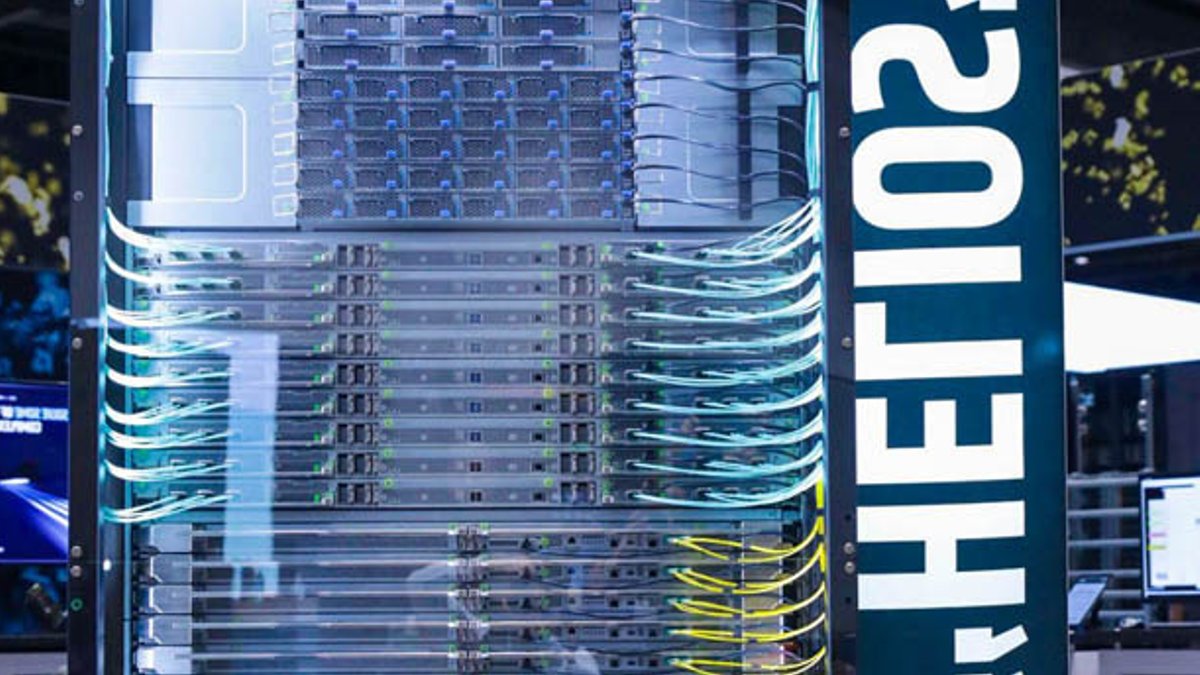
AMD’s Helios rack is the company’s answer to the growing need for infrastructure that exceeds the limits of a single server. At this year’s Advancing AI event, the semi-formal launch of the Helios system marked a major milestone for AMD, bringing together its EPYC 9006 “Venice” CPUs, Instinct MI455X GPUs, and Pensando DPUs into a single, coherent appliance. The result is a “rackscale system” designed to function as one massive machine rather than a cluster of disconnected parts, directly challenging the dominance of rival NVIDIA in the datacenter AI space.
The technology behind a rackscale system is conceptually straightforward, but the execution requires a high-performance fabric to link components together. AMD had been gathering these pieces over the past few years, culminating in its 2022 acquisition of Pensando to provide the necessary networking hardware. Now, the four-year journey is complete, and Helios is the first true implementation of this vision in production.
Helios relies on a sophisticated architecture that connects the 72 GPUs within the rack through a massive scale-up network. This internal fabric allows the nodes to communicate at incredible speeds, effectively acting as a single system. Beyond the rack, the system uses scale-out networking to link multiple Helios units together for larger deployments.
Raw Performance Numbers
The shipping specifications for the Helios rack ended up being remarkably close to AMD’s original projections. The system delivers 2.9 EFLOPS of peak MXFP4 compute performance. These GPUs are paired with HBM4 memory, offering a total of 31TB of memory capacity and a cumulative bandwidth of 1.7PB/second. The bandwidth per GPU is actually about 21% higher than originally planned, which is a significant boost in a market where memory bottlenecks are a primary constraint.
Related: Top 4 Cell Phone Design Trends To Watch Out For.
Network performance is equally substantial. The scale-up domain within a Helios rack offers 260TB/second of cumulative bandwidth between nodes. When connecting to external infrastructure, the scale-out domain provides 43TB/second of bandwidth. These figures highlight the sheer volume of data the system can move, a critical factor for modern AI workloads that require constant data access.
From a practical standpoint, the significance of this architecture cannot be overstated. For data center operators, moving beyond a single server is often less about buying more boxes and more about rethinking how those boxes communicate. The Helios system forces a shift from simply adding hardware to designing a unified computing environment where the network is as critical as the processor itself. By integrating the CPU, GPU, and DPU into a single rack, AMD is attempting to solve the latency and overhead issues that typically plague traditional clusters. This integrated approach aims to streamline operations, allowing developers to focus on algorithms rather than managing complex interconnect configurations. The shift toward unified infrastructure is part of a broader movement toward more cohesive hardware solutions. Design trends in computing hardware are increasingly focused on integrating diverse components to optimize performance and reduce physical footprint.
AMD’s approach to this problem differs from its main competitor. The company has focused on bringing all necessary elements—processing, memory, and networking—under one roof. This strategy contrasts with the modular approach often seen in other data center setups, where components are added separately to address specific needs. By bundling these elements, AMD hopes to reduce the complexity that arises when trying to mix and match different vendors’ hardware.